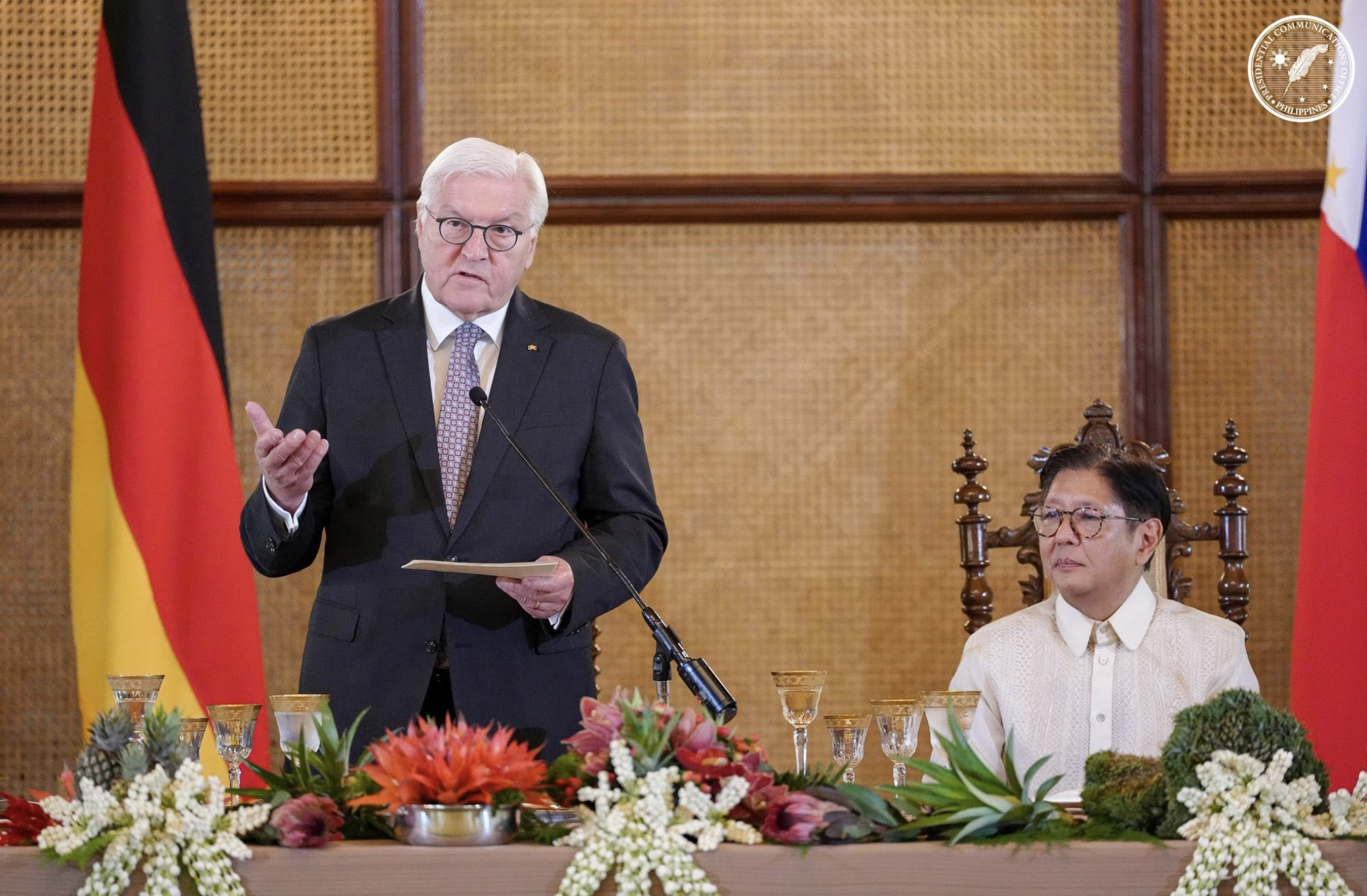
The Philippines and Germany pledged to deepen cooperation in renewable energy, with President Ferdinand R. Marcos Jr. on Tuesday highlighting German technology and investment as important to the country’s clean energy transition.
Speaking after bilateral talks with German President Frank-Walter Steinmeier at Malacañang Palace, Marcos said the two countries share ambitions in renewable energy and are well positioned to work together by combining Germany’s technological expertise with the Philippines’ abundant natural resources.
“We share ambitions in renewable energy collaboration, leveraging Germany’s technology and the Philippines’ natural resources, making us natural partners in this sector,” Marcos said in a joint statement.
The renewed commitment comes as the Philippines ramps up efforts to expand clean energy capacity and attract foreign investment into the sector.
The government aims to increase the share of renewable energy in the country’s power generation mix to 35% by 2030 and 50% by 2040, while policy reforms allowing up to 100% foreign ownership of renewable energy projects have opened new opportunities for international investors.
The Philippines has also been actively courting European investment in renewable energy as it seeks to reduce its reliance on imported fossil fuels and strengthen energy security amid rising electricity demand.
Germany is regarded as one of the world’s leaders in renewable energy development through its Energiewende, or energy transition strategy, with expertise spanning offshore wind, solar power, battery storage, green hydrogen and power grid technologies.
The Philippines has been pursuing similar priorities, including the development of offshore wind projects, utility-scale solar farms, energy storage systems and modern transmission infrastructure needed to integrate more renewable power into the national grid.
“Our relations with Germany are important not just because our portfolio of cooperation spans a wide array of sectors, but because these partnerships and projects have proven to be successful and beneficial to our national development efforts,” Marcos said.
The two leaders discussed broader cooperation covering trade and investment, climate change, economic development and labour, with renewable energy identified as one of the priority areas for future collaboration.
Germany has also supported Philippine development initiatives through the German Agency for International Cooperation (GIZ), including programmes focused on climate resilience, sustainable development, technical training and capacity building.
Beyond energy cooperation, Marcos described Germany as the Philippines’ largest trading and investment partner within the European Union, with bilateral trade reaching around $5.5 billion and net foreign direct investments amounting to $10.26 million in 2025.
German companies including Siemens, Lufthansa Technik, Deutsche Bank, Bayer and Bosch have established operations in the Philippines, contributing to economic growth and technology transfer.
Marcos also welcomed Germany’s support for the swift conclusion of a free trade agreement between the Philippines and the European Union, with the sixth round of negotiations held in Manila in May.
The two countries likewise reaffirmed their commitment to a rules-based international order and discussed regional and global security issues, including developments in the Indo-Pacific.
Steinmeier said his state visit underscored Germany’s commitment to strengthening ties with the Philippines as a like-minded partner.
“Our cooperation is not only marked by international and regional developments. Our peoples too, continue to grow together,” Steinmeier said.
The German president also highlighted the contributions of around 45,000 Filipinos living and working in Germany, many of whom are employed in healthcare and other skilled professions.
The renewed commitment comes as the Philippines seeks to attract more foreign participation in renewable energy projects following policy reforms that opened the sector to full foreign ownership.
European partners, including Germany, are expected to play an increasing role in areas such as offshore wind, solar power, battery storage, grid modernisation and other clean energy technologies.