
Renewable energy projects account for more than four-fifths of the Philippines’ committed power generation pipeline, according to Department of Energy (DOE) data as of May 2026.
The DOE’s Annual Summary of Target Commercial Operation showed the country has 26,842 megawatts (MW) of committed power projects with target commercial operation dates through 2031 and beyond, including projects with schedules still to be determined.
Of the total, renewable energy projects account for 22,593 MW, or 84.17%, while non-renewable projects represent 4,250 MW, or 15.83%.
Solar projects dominate the committed pipeline with 16,337 MW, equivalent to 60.86% of total capacity. Wind projects follow with 5,377 MW, or 20.03%. Hydropower accounts for 834 MW, while biomass and geothermal projects contribute 39 MW and 6 MW, respectively.
The non-renewable pipeline consists mainly of coal projects at 3,074 MW and natural gas projects at 1,100 MW. Oil-fired projects account for 76 MW.
The DOE data also showed 2,979 MW of committed energy storage projects. These include 1,854 MW of standalone battery energy storage systems and 1,125 MW of integrated renewable energy and energy storage systems.
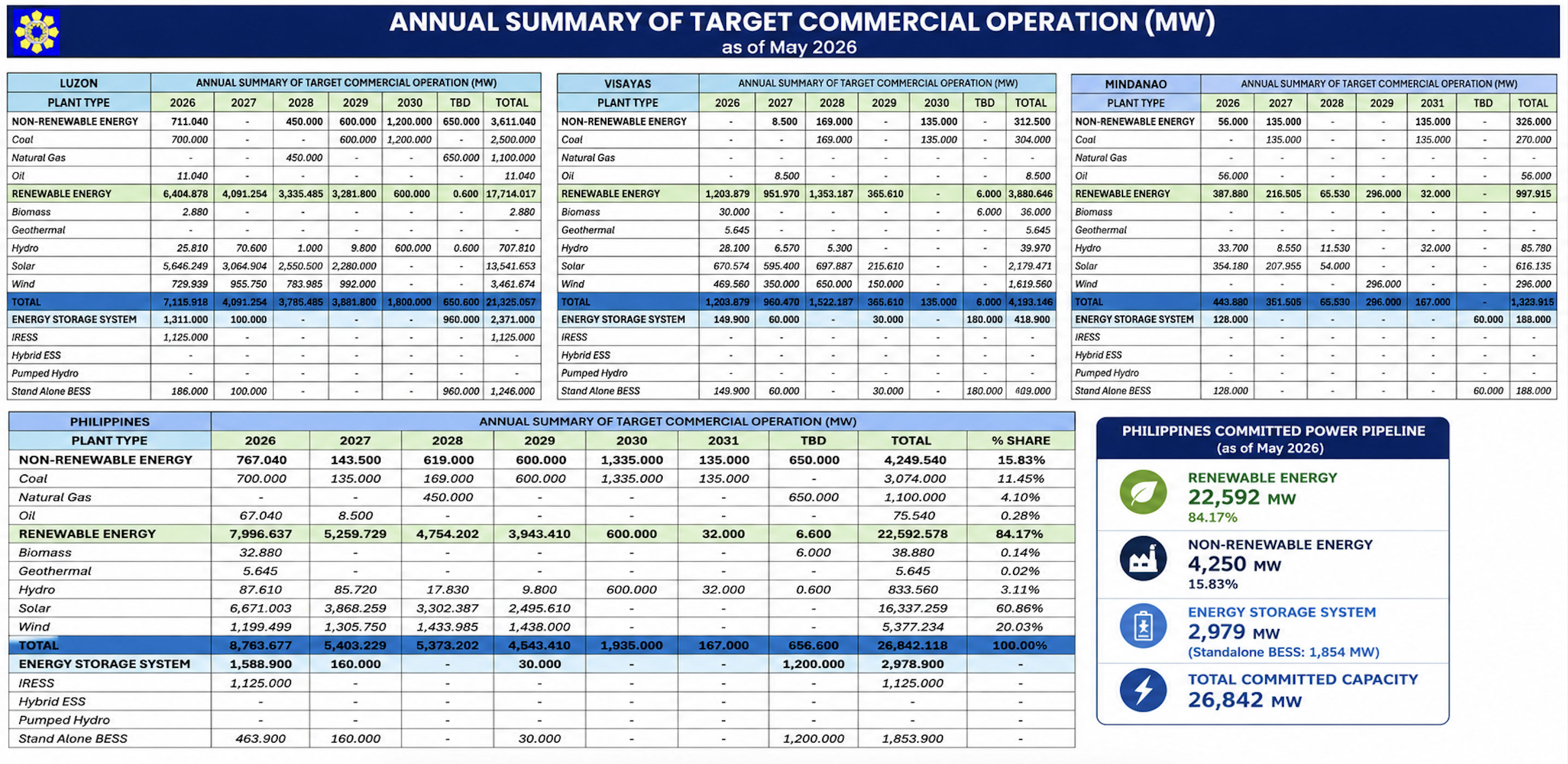
Luzon accounts for the bulk of the country’s committed power projects, with 21,325 MW in the pipeline. This includes 17,714 MW of renewable energy projects and 3,611 MW of non-renewable capacity.
In the Visayas, committed power projects total 4,193 MW, led by 3,881 MW of renewable energy capacity. Mindanao has 1,324 MW of committed power projects, including 998 MW from renewable energy sources.
For 2026 alone, 8,764 MW of committed power projects are targeted to start commercial operation, including 7,997 MW of renewable energy projects. Solar accounts for the largest share of the 2026 pipeline at 6,671 MW, followed by wind at 1,199 MW.
The figures show solar, wind and energy storage projects making up the majority of the country’s committed capacity additions as the Philippines works to expand supply and support its energy transition goals.